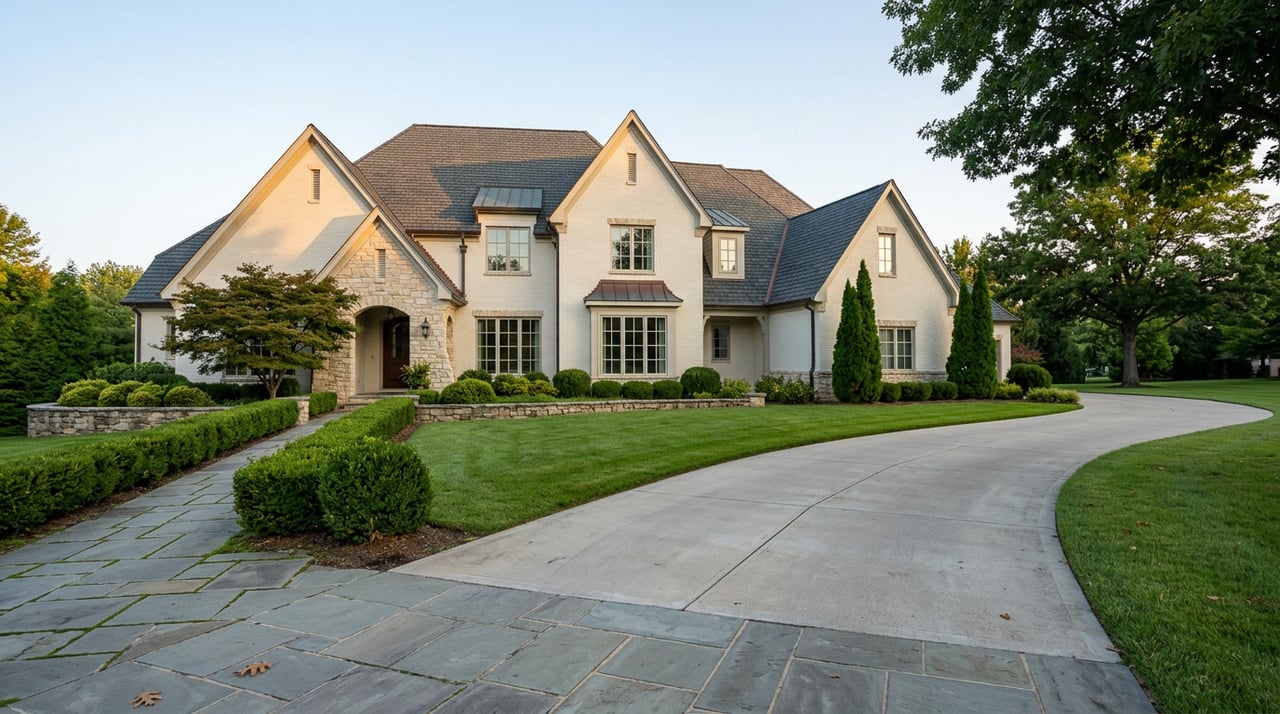
Two homes, one gated stone entrance off Garffe Sherron Road in northern Wake County. One buyer signed a contract within 24 hours of the listing going live. The other seller has been showing a nearly identical home, a 4,771-square-foot new build on a .92-acre lot, for well over a year. As of this fall, that second listing had logged 489 days on market. A third active listing nearby, a 0.93-acre new-construction lot with a three-car garage, has been sitting for 654 days.
Same neighborhood. Same builders' association. Same gate code, essentially. Radically different clocks.
If you've been comparing Grand Highland Estates against other North Raleigh and Wake Forest custom-build communities, you've probably seen the headline numbers: list prices ranging from roughly $1.9 million into the $3 million range, lots from 0.90 acres up to 2.5 acres, an HOA that runs about $125 a month. What those numbers don't tell you is that this community isn't behaving like one market. It's behaving like two, running on different timelines, and the gap between them is the thing worth understanding before you write an offer or list a lot.
Two Markets Wearing One Gate
Grand Highland Estates was built out on what was once a working dairy farm, and the developers who reshaped that land brought in a roster of builders rather than a single production company. Over the life of the community, at least seven builders have put homes on the ground here: EDK Design Build, Exeter Building Company, Hearthstone Luxury Homes, Paragon Building Group, Raleigh Custom Homes, Shail Construction, and Speight Built Homes. Each one works differently, and that difference is the whole story.
Some of these builders sell move-in-ready or near-complete spec homes, built on a schedule that isn't waiting for a specific buyer's floor plan preferences. Those homes tend to move fast, because the buyer isn't choosing finishes from scratch, they're choosing from what's already built or close to it. Other builders in the same community work almost entirely custom, starting from a lot and a buyer's vision and building to that exact specification. Those homes take longer to sell for the plainest reason possible: they were never designed to appeal to the broadest number of people. They were designed to appeal to one household, and the next buyer has to be a genuine match for someone else's choices in stone, cabinetry, and floor plan.
That's the mechanism behind the 1-day sale and the 489-day wait. It isn't that one home is desirable and the other isn't. It's that they were built for two different kinds of buyers moving at two different speeds, and a single median list price flattens that difference into one number that describes neither home accurately.
What the Price-per-Square-Foot Spread Actually Shows
The same pattern shows up in price per square foot. Active listings in the community this fall included a 5,366-square-foot home on Legacy Ridge Lane priced around $405 a square foot, and a smaller 4,607-square-foot home on Stream Manor Court, sitting on a 1.8-acre lot, priced closer to $488 a square foot.
That's not a pricing mistake on either end. Larger homes typically post a lower price per square foot because a big chunk of the build cost, foundation, roofline, mechanical systems, doesn't scale up linearly with size. Smaller homes on larger or more desirable lots can carry a higher per-square-foot number because the buyer is paying for land and positioning as much as square footage.
If you're comparing two listings in Grand Highland Estates and only looking at the sticker price, you'll miss this. The per-square-foot number tells you where the value actually sits, in the structure or in the ground it's sitting on, and that distinction changes what you should be negotiating on.
Reading the Gap Before You Write an Offer
Here's how that translates into decisions, whether you're touring finished inventory or sitting down with a builder to plan a custom lot:
Ask who built it and how it came to market. A home from a builder known for quick-move-in spec product is priced to move and probably has less room for negotiation. A home from a builder that works exclusively custom, sitting past a year on market, may have more room, not because something is wrong with it, but because it's waiting for the right buyer rather than any buyer.
Check the lot size against the price per square foot, not just the price. A higher per-square-foot number on a smaller home with a premium lot is a different value proposition than the same number on a smaller home with a standard lot.
Don't read a long days-on-market number as a red flag by itself. In a community built around fully custom architecture, time on market often reflects the narrowness of the target buyer, not a problem with the home. That distinction matters if you're deciding whether to negotiate or whether to walk.
If you're building rather than buying resale, choose your builder with this pattern in mind. A buyer who wants speed and predictability is looking for a different builder relationship than a buyer who wants full customization and is willing to wait for the right lot and design partner.
The HOA Number That Looks Too Low, Until You See What It's Not Paying For
One more number worth sitting with: the HOA dues here run about $125 a month, modest for a gated community at this price point. Compare that to gated neighborhoods built around a clubhouse, pool, and tennis courts, where dues routinely run several times higher.
Grand Highland Estates doesn't have a clubhouse or a shared pool. The amenity here is the land itself, private roads, mature trees, and lots big enough that most homeowners aren't looking for a community pool because they have room for their own. The low HOA isn't a bargain. It's the other side of a tradeoff: you're paying for acreage and privacy instead of shared recreation, and the dues reflect a community with almost nothing to maintain collectively.
That's worth knowing if you're comparing this community against other gated North Raleigh neighborhoods with higher dues and more built amenities. The comparison isn't apples to apples, and the HOA line item is one of the clearest signals of that difference.
Frequently Asked Questions
Does a long time on market mean something is wrong with a home in Grand Highland Estates? Not necessarily. Custom-built homes in this community are often designed around one buyer's specific taste, and finding the next buyer who wants that exact combination of floor plan, finishes, and lot can take considerably longer than selling a spec home built for broader appeal.
Why is the HOA fee so low for a gated community at this price point? The dues here cover private roads, the gated entrance, and landscaping along shared areas. There's no clubhouse, pool, or court complex to maintain, so the monthly cost stays modest compared to gated communities built around shared amenities.
Can I buy a lot and choose my own builder in Grand Highland Estates? The community works with an approved roster of builders rather than an open build list, so the process runs through selecting a lot and pairing with one of the builders already established there.
Working the Community From the Inside
Raleigh Custom Homes is one of the builders shaping Grand Highland Estates, and it's the same builder Wall Real Estate Group works alongside through its Raleigh Custom Realty affiliation. That means we're not reading this community from the outside through a portal search. We're tracking which lots are moving, which builders have inventory ready now, and which custom slots are worth waiting for, in real time.
If you're comparing Grand Highland Estates against other North Raleigh and Wake Forest custom communities, or you're trying to figure out whether a specific listing's time on market is a warning sign or an opportunity, we can walk you through what we're actually seeing on the ground. Schedule a private consultation with our team, or ask for a home valuation report if you're the one weighing when to list.