Walk to the back corner of Linville, past the last cul-de-sac of estate lots, and you'll find a break in the tree line and a path. It leads off Linville's own property, across a boundary line, onto the grounds of the neighborhood next door. That path is how Linville residents reach a swimming pavilion, a tennis court, and a children's play area. None of it sits inside Linville's gates. None of it belongs to Linville's homeowners association.
You wouldn't know that from reading about the neighborhood online. At least three separate brokerage overviews of Linville list a pool, tennis courts, and a children's park as if they were part of the community's own amenity package, the same way you'd describe a clubhouse or a gatehouse. One neighborhood-specific site gets it right, describing the walking path to the adjoining community and what it actually provides. Records for the Linville Owners Association filed with the state's HOA document registry don't show recreation facilities among what the association maintains. The pool and courts belong to Stonemoor, the neighborhood on the other side of that path, whose own HOA does list a swimming pool, tennis courts, trails, and a playground as facilities it owns and funds.
That distinction sounds small until you're the one paying dues, negotiating a resale, or trying to figure out what happens if the arrangement ever changes.
What Linville's HOA Actually Owns
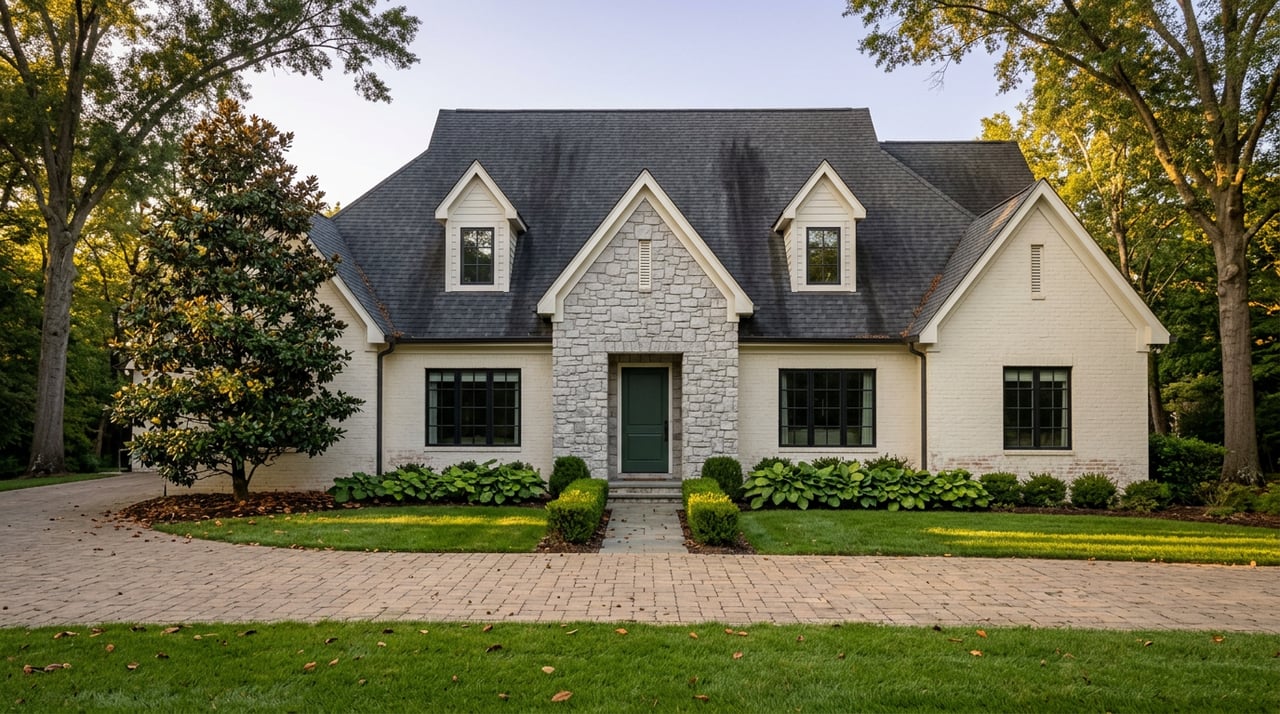
Linville was built out between 2005 and 2009 as 46 estate lots ranging from roughly one acre to more than seven, developed to evoke the mountain communities its name borrows from, with winding streets, natural creek buffers, and mature hardwood cover rather than a manufactured park setting. Homes here run from around 6,000 to 12,000 square feet, built by a roster of local custom builders that includes Hurst Built, Bost Custom Homes, Don Collins Builder, Mark Massengill, Jayco Construction, Phil Miller Construction, Silver Crest Homes, Pinnacle Construction Group, and Stephen Dilger. It's a genuinely well-built enclave, and the estate scale is real.
What isn't real, or at least isn't Linville's, is the recreation infrastructure that so many overviews attach to it. The pool and tennis court sit on Stonemoor's side of the property line. Access runs through a walking path, not through a jointly owned and jointly funded facility. That's a meaningfully different legal and financial arrangement than owning the asset outright, and it's the kind of detail that only shows up when someone checks the HOA's actual governing documents rather than repeating what the last site said.
Why This Isn't Just a Linville Problem
Once you start checking amenity claims against the underlying HOA structure instead of the marketing copy, the pattern shows up across this whole cluster of North Raleigh gated communities, and it isn't consistent from one source to the next.
Take Barony, off Creedmoor Road. One overview describes it flatly: no clubhouse, no shared community amenities, homes built around private pools instead. Another describes the opposite, listing a private lake, walking trails, clubhouse, swimming pool, and tennis courts as if they were standard Barony features. A third describes "private parks" and "upscale clubhouses" without specifying whether those are shared or attached to individual lots. Three sources, three different answers, about the same 80-acre neighborhood.
Here's how the claims and the underlying structure line up across the cluster, based on what each community's own HOA appears to actually maintain versus what gets repeated about it:
| Community | What Gets Repeated Online | What the Ownership Structure Appears to Be |
|---|---|---|
| Linville | Pool, tennis courts, children's play area listed as neighborhood amenities | Owned and maintained by Stonemoor's HOA; Linville residents reach it via a walking path, not a jointly held facility |
| Stonemoor | Same pool and tennis facility described as its own amenity | Consistent across sources; Stonemoor's HOA maintains the pool, courts, trails, and playground directly |
| Barony | Described in one place as having no clubhouse or shared amenities, elsewhere as having a full clubhouse, pool, and tennis courts | Unclear and contradictory; homes here typically carry their own private pools, and the neighborhood's identity centers on its 12-acre lake and lakefront lots rather than a shared rec building |
| Olde Raleigh | Clubhouse, pool, two tennis courts, three small lakes | Consistent across sources; a fully self-contained, HOA-owned package |
| Bay Leaf Farm | No shared clubhouse; amenities described as varying lot to lot | Consistent; features like geothermal systems, indoor water features, and private sports courts live inside individual homes, not in a community building |
Two of these five communities have a clean story. Three don't. That split is the actual finding here: it isn't that gated North Raleigh neighborhoods are inconsistently amenitized, it's that the content describing them is inconsistently sourced, and buyers rarely find out which category they're in until they're deep into due diligence.
Why the Confusion Keeps Spreading
The likely explanation isn't malicious. It's structural. Neighborhood overview pages get written once, then get lightly rewritten by the next site, and the next, each pass carrying forward whatever the previous page claimed without a fresh check against the HOA's actual filings. A pool that belongs to the neighborhood next door gets folded into the subject neighborhood's own amenity list somewhere along that chain, and after enough repetitions it reads as settled fact. Nobody along the way pulled the governing documents. It's easier to describe an entire cluster of gated communities as interchangeable, all offering "pools, tennis courts, and lakeside walking trails," than to check which HOA is actually paying to resurface which pool.
That's a problem for anyone using these overviews to compare neighborhoods, because the financial and practical consequences of the two structures are not the same.
What This Actually Means If You're Comparing These Neighborhoods
If you're weighing Linville against Stonemoor, Barony, Olde Raleigh, or Bay Leaf Farm, the amenity question isn't really "does it have a pool." It's "who owns the pool, and what's your recourse if that ownership ever changes."
A few questions worth asking directly, before you write an offer in any of these communities:
- Does your specific HOA's reserve study include a line item for pool or court maintenance, or is that facility owned by a different association entirely?
- If access runs through an adjoining neighborhood, is that access secured by a recorded easement, or by an informal understanding that could be revisited by the other HOA's board?
- Do guest privileges, hours, or usage fees for that shared facility get set by your association, or by the one that actually owns it?
- If the facility needs a major capital repair, whose dues fund it, and do you have any vote in that decision?
None of these questions show up in a standard amenity list. All of them show up in the HOA's governing documents and reserve studies, which are public records a buyer can request and review before closing.
FAQ
Does this mean Linville residents don't actually get pool and tennis access? No. The access is real, it just runs through a path onto Stonemoor's property rather than through a facility Linville's own HOA owns. The practical experience for a resident may be identical to owning the amenity outright. The financial and governance structure behind it is not.
Is there a North Raleigh gated community in this group that owns its amenities outright and where the sourcing is actually consistent? Based on what's publicly described, Olde Raleigh is the cleanest example: its clubhouse, pool, tennis courts, and small lakes are consistently attributed to its own HOA across the sources that describe it, without the contradictions that show up around Barony or the shared-access structure at Linville.
Why does this matter more in a gated community than in a typical subdivision? Gated communities market privacy and amenity access as part of the price. If the amenity you're paying for through dues or expecting through proximity is actually controlled by a neighboring association, your long-term access depends on decisions you have no vote in.
If you're comparing gated North Raleigh neighborhoods and want someone who checks the HOA filings before making a claim about what's actually included, Wall Real Estate Group can walk the governing documents with you before you write an offer. Schedule a private consultation, or start with a free home valuation if you're the one selling into this market.